Showing posts with label h piling. Show all posts

Thursday, 11 December 2014

Learning More about Steel Sheet Suppliers


                                  Steel sheet is a thin metal sheet of stainless steel up to 6mm thick. While sheets of stainless steel that are thicker than 6mm also exist in the market, they are usually called as stainless steel plate. To avoid confusion, a distinction needs to be observed between sheet metal and plate metal. Steel sheet, unlike the plate metal, has a high surface area to volume ratio. Apart from thickness and physical properties, sheet and plate metals have different applications. 

Steel Pipe Suppliers

                                   Plate metal is generally used in large structures like ships, bridges, turbines, skyscrapers etc. Sheet metal is instead used in our day to day life objects and machines like cars, trains, planes, computers, home appliances, farm equipment, office furniture, machine components and even soda cans. The manufacturing processes for both the type of metals are also different. Forming a sheet of steel metal involves a lot of processes that manufacture parts for a vast amount of purposes. The stock used for steel sheet metal processes is usually formed by rolling and comes in coils. Some of these processes may be applied to plate metal as well however plate, because of it’s thickness, has its own set of problems in processing. Therefore, some of the sheet metal functions and operations do not apply to plate metal.
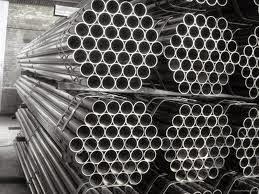
                                   
Steel Pipe

                                   Let’s discuss the manufacturing processes of sheet metal a little more in detail. Though Steel Sheet Suppliers may not involve directly into any of these steps, an understanding of what goes into behind making of the sheet metal helps them market their business better. Sheet metal is manufactured mostly on a press and parts are formed between two die. The upper die is called as a punch. Sheet metal parts, referenced to as stampings sometimes, are usually economical and easy to produce in large numbers. Sheet metal is formed cold. Usually for sheet metal applications there is no change, or hardly any negligible change in the sheet thickness. For certain processes which include deep drawing, there is a small or expected change in thickness, but in most cases this may be also neglected. Sheet metal produces parts that typically have high strength, good surface and accurate tolerances. 

H Pile

                                 Stainless steel sheet is available in a variety of grades, sizes, types and finishes. Some of them are also available in H sections or H piles, for providing a deep foundation of structures. The process of manufacturing such H sections is also called as H Piling.


Tuesday, 21 October 2014

Seven Solutions for Cold Rolled Sheet Pile


                      Cold rolled steel has many end uses that make it essential to many manufacturing companies.  Each of the sizes of cold formed sheet pile has a particular purpose to serve in various applications.  Sizes of the pile sections are classified by their measurements and surface areas. 

Z Series Sheet Pile

With five options to choose from, sheet pile sections in the Lightweight Z Series come in laying widths from 24 ½ to 25 inches wide.  Wall depths of these sections range from a few hundredths of an inch less than 4 ½ inches to a few hundredths more than 4 ½ inches.  Overall section area for this series of piles varies between 5 square inches up to 7 ½ square inches.

steel sheet piling

             Sheet pile sections of the Intermediate Z Series are just narrower than the lightweight pile options, measuring in at roughly 22 inches. However, the wall depth of this series is 3 inches deeper than its lightweight counterpart, roughly 7 ½ inches.  Intermediate sheet piles share a similar overall section area when compared to the lightweight piles, ranging between 5 square inches up to 7 ½ square inches.

            Next in the Z Series sheet pile line is an intermediate heavy option.  These sections of sheet pile are 2 ¾ wider than the lightweight option and 2 inches deeper than the intermediate option.  Sections measure in at 26 ¾ inches wide and 9 ⅖ inches deep.  Average section area for this series is roughly 12 square inches per pile.  That is almost double the section area (in square inches) of the two smaller pile solutions. Intermediate Heavy Z Series sheet piles are also offered in 6 different size sections, whereas the most sizes any other option offers is 5.
                                  
                                   
h Piling

            Looking for a sheet pile with a depth of more than 10 inches?  Pile sections in the Mid Heavy Z Series fall into that category with a depth of 10 ¾ inches.  Even with a narrower laying width, the area of each pile is similar to that of the Intermediate Heavy Z Series.  The similarity in area is largely due to the increased depth of the mid heavy option. 

            A Heavy Z Series pile is only offered in four section sizes.  With all available choices in this series being virtually similar in laying width and depth, the differences lie within the section area.  Each section is offered with a width of 22 inches long, and a depth of 12 ¼ inches.  The section area of each pile is 12, 13, 13 ¼, and 14 ¼ square inches respectively.  Compared to smaller styles, this series of piling is quite something.

                                               
cold rolled sheet pile

            Mega Z-18 Series sections are 1 of 2 sheet pile styles that fall into the “heavy duty” category.  Wall depth and laying width of sections in this series are virtually the same across all five options.  Laying width across all solutions is 29 inches while the wall depth is 17 ¼ for each available pile in the series.  Section area per pile makes a drastic jump when comparing mega series piles to the heavy series alternative.  This particular series has an average section area just over 16 ¾ square inches, that is over 4 square inches larger than an intermediate series pile.

            The last series of cold rolled sheet pile is the Mega Z-19 Series.  Each of the four available section options have a monstrous wall depth measuring in just under 18 inches.  Just as there is a uniform wall depth, the laying width is uniform as well at 27 ½ inches for all sections.  When stacking up the Z-19 Series against the Z-18 Series, the Z-19 Series has a larger section area which is barely under 17 ½ square inches.  Talk about a massive steel wall.

        
cold formed sheet pile

Conclusion:

            Every size of sheet pile serves a particular purpose in a certain application.  Some situations may require a smaller pile with very little surface area.  Larger projects may be better suited by using a sheet pile that is wide and deep with a significant amount of surface area.  No matter the project, the sheet pile Z Series has something the get the job done.


Monday, 29 September 2014

Are Steel Tubes Contributing to Tainted Water in Shale-Gas Areas?


Recent studies have emerged placing blame on steel tubes and bad cement for tainted drinking water in shale-gas areas.  Hydraulic fracturing was previously suggested to be the cause for water contamination in areas where natural gas is produced.  A new analysis published in The Proceedings of the National Academy of Sciences has confirmed what many have believed as of late.  The analysis proclaims, “there is no evidence that fractured shale led to water contamination” near several natural gas drill sites in Pennsylvania and Texas.   Fault lies with, for the time being, improperly built wells which lead to gas leaking up the wells into aquifers.


steel tubes


            The first step in the extraction of natural gas is carried out by gas producers who drill a deep vertical well which extends horizontally in several different directions.  Picture these expansion shafts as spokes protruding from a center hub.  A combination of steel pipe and cement are then used to line and seal the outside of the vertical wells.  What happens next is referred to as hydraulic fracturing or fracking.  Fracking involves injecting water and chemicals at high pressures into the “spokes”, creating fissures and releasing the natural gas trapped within the shale.  Why hydraulic fracturing was initially thought to cause gas to migrate into drinking water aquifers is a plausible explanation.  However, researchers concluded that fissures created by fracking are not long enough to affect aquifers. 

steel pipe

Thus, attention was focused on the next possible cause, gas leaking out of the steel lined and cement sealed vertical well.  Unfortunately, well integrity is a widespread problem in the oil and gas industry.  Scott Anderson, who deals with energy production issues for the Environmental Defense Fund, revealed that “15% of all cement sealing of wells may be imperfect”.  Mr. Anderson believes that improvements in well integrity could eliminate environmental problems caused by gas leaks.  He even offers suggestions that gas producers could us in taking steps towards eliminating leaks.  For example, ensure the proper cement and steel tubing is used as well as monitor pressures during well construction and while gas is flowing. 

cold rolled sheet pile


Could imperfect wells be related to smaller companies with a lack of drilling experience in some shale-gas areas?  There are statistics that show a correlation between larger companies drilling better wells.  Although, according to Scott Anderson, this may not necessarily be true.  “Some of the best wells, from a technical standpoint, are drilled by the smallest operations.”

h pile


Now that the cause of the issue at hand has been determined, will the government implement changes to the process of natural gas production?  What steps will gas companies implement in order to prevent leaks from occurring in the future?  Hopefully imperfect wells are not the result of pure negligence by gas companies and there really are improvements that can be made towards improving well integrity.

Wednesday, 10 September 2014

Hoesch Your Daddy? Hoesch Steel Sheet Pile Sealing System


In the world of steel sheet pile seepage prevention the hoesch sheet pile sealing system reigns supreme. Capable of taking an already quite impermeable steel wall to the next level of defense are two polyurethane seals on either side of each section of sheet piling. Both seals act like a bouncer at a nightclub, keeping out possible contaminants from slipping through the piling interlocks.

hoesch sheet pile

For each seal to perform at its optimum level every section of sheet piling has to be placed in a specific direction. Either side of the steel piling has a specific purpose which in turn gives each side a name. One side is referred to as the “threading” side because it guides in the opposite side of the next piece of piling. That opposite side is called the “driving” side which it gets from being driven into a piling that was already placed. With each side of the piling having a specific purpose, each seal is factory fitted and groomed to optimize efficiency when placing the sheet pile.

h piling


Getting each seal to line up properly with its counterpart is no easy task. Do not forget to mention every seal has to sustain its superb level of impermeability. Assisting with the sealing process is a biodegradable lubricant that must be used prior to driving. Not only does it work like WD-40, but it also displays adhesive properties quite well. Better yet, this lubricant is water resistant is since it’s biodegradable be used in protected drinking water zones.

line pipe suppliers


Each strip of polyurethane seal reinforce the already impressive resistance to the elements that steel piles possess. Nothing can get by a steel piling sealing system such as the Hoesch.

From dredging, remediation, even containing contaminated areas; a whole lot of nothing can overpower this beast of a sealing operation. The Hoesch interlock system mine as well adopt a theme song such as “Mr. Big Stuff” and dedicate it to every foe in any future encounter.